Resume objective: when to use one and how to write it
Learn when a resume objective helps, when a summary works better, and how to turn a generic statement into a specific, credible example.


Career centers differ on whether to include one. The University of Wisconsin–Madison calls objectives optional and suggests them for career changes or applicants with limited relevant accomplishments. Texas Tech University’s career center recommends tailoring your resume so you do not need an objective at all. Choose the approach that adds information for your application.
What is a resume objective?
A resume objective is a short statement near the top of your resume, below your contact details. It identifies the kind of role you want and the relevant experience or skills you can bring. It is usually a sentence or two, not a paragraph about your personal ambitions.
A useful objective answers two questions: Which role are you applying for? What can you already contribute? Penn State Harrisburg’s career guidance recommends a concise, job-focused statement and warns against vague promises about personal growth.
The heading can simply be Objective. Your name and contact information still come first. If the employer provides a required resume format, follow it. Our guide to resume sections shows where the opening sits among the other sections.
Objective, summary, or neither?
A resume objective points toward the role you want. A summary leads with experience and accomplishments you already have. Neither section is mandatory. The best choice depends on what the reader still needs to understand after seeing your job titles and experience.
| Your situation | A useful starting choice | Why |
|---|---|---|
| Student or first job | Targeted objective, or no opener | Name the role and transferable skills if your experience does not make the goal obvious. |
| Changing careers | Targeted objective | Explain the new direction and connect it to credible experience. |
| Returning after a break | Objective or brief summary | Show the current target role without turning the opening into an explanation of the gap. |
| Experienced in the same field | Summary, or no opener | Lead with strong relevant work rather than repeating a familiar job title. |
These are editing choices, not hiring rules. UC Santa Barbara’s career center notes disagreement among advisers: a targeted objective may help focus a resume, but a weak one takes up valuable space. Emory University’s career guidance also treats objectives as optional and recommends focusing on skills offered rather than benefits sought.
If your cover letter already explains a career change, you might not need to repeat that explanation at the top of the resume.
How to write a job-specific resume objective
Start with the job posting, then check what your experience can honestly support.
- Name the target role. Use the employer’s job title when it accurately describes the position you want.
- Choose relevant strengths. Pick skills requested in the posting that are already demonstrated in your work, education, volunteering, or projects. Our resume keywords guide shows how to find those terms in a posting.
- Add one piece of evidence. Mention a task you have done, a tool you have used, or a problem you have solved. Keep the evidence specific enough to defend in an interview.
- Write for the employer’s needs. Replace “a chance to grow” with an ability you can contribute.
- Edit it down. Aim for one or two clear sentences, and remove phrases that fit every job posting equally well.
For most applications, two or three displayed lines are a reasonable editing target, not an ATS requirement. The words should still make sense when read without the rest of the resume.
Worked example: retail supervisor to customer success
Meet Jordan Ellis, a fictional retail supervisor applying to Northstar Learning, a fictional company. This example shows how to connect a career change to real transferable duties without pretending Jordan has experience they do not.
Here is an illustrative excerpt from the Customer Success Associate posting:
Help customers with product questions, document inquiries and follow-ups, support customer onboarding, and coordinate unresolved issues with the support team. Experience using a customer relationship management (CRM) tool is welcome.
Jordan’s fictional resume already describes customer inquiries, training new staff, and writing handoff notes. It does not establish that Jordan has onboarded customers or worked in a CRM. We should not quietly add either claim.
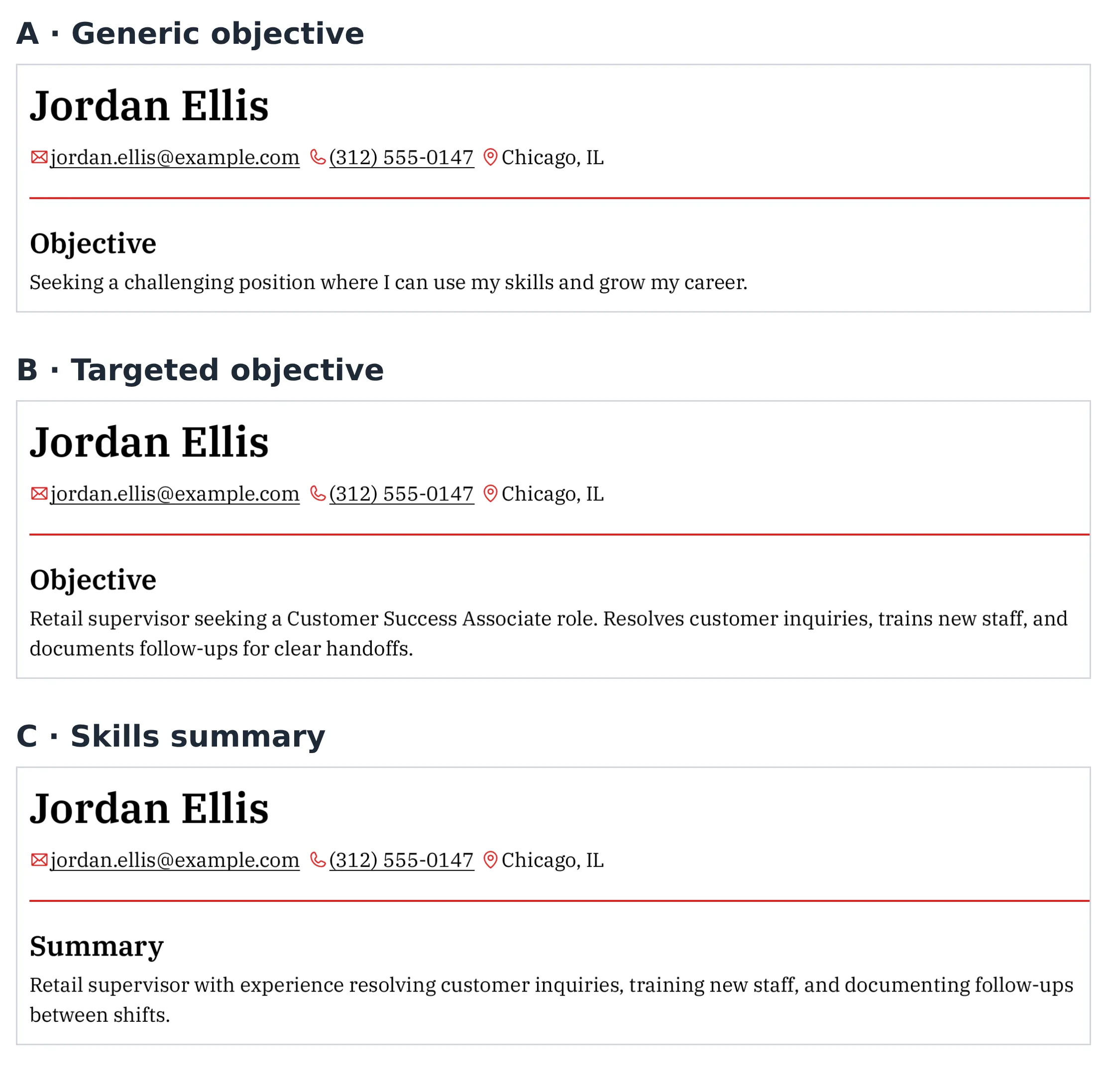
A. Generic objective
Seeking a challenging position where I can use my skills and grow my career.
This could belong to almost anyone. It does not name the job or give the reader a reason to connect Jordan’s retail experience to customer success.
B. Targeted objective
Retail supervisor seeking a Customer Success Associate role. Resolves customer inquiries, trains new staff, and documents follow-ups for clear handoffs.
The target role is named. Each supporting detail appears in Jordan’s existing work history. Training employees is not presented as customer onboarding, and the objective does not claim CRM experience.
C. Skills summary
Retail supervisor with experience resolving customer inquiries, training new staff, and documenting follow-ups between shifts.
This version emphasizes the experience rather than the future job title. For a resume already tailored clearly to customer success, it may be enough. Version B is more helpful if the career change otherwise looks confusing.
The three panels show the top of Jordan’s fictional resume, exported from the ResumeUnbox editor. The contact details stay the same. Only the objective or summary changes; the shared work-history bullets appear just below the figure.
The shared fictional work-history bullets are:
- Responded to customer inquiries and resolved issues at the service desk.
- Trained new team members on store procedures and customer communication.
- Documented unresolved issues for follow-up by the next shift.
- Kept handoff notes in a shared spreadsheet.
Those bullets are the evidence for the targeted statement. The stronger wording does not depend on inventing accomplishments.
What our checker showed for A, B and C
We built Jordan’s full resume in the ResumeUnbox editor in four versions that differ only in the opening: A, B, C, and D with no opening at all. Everything else is the same in each version: the bullets above, two earlier retail jobs, a Skills section and an associate degree. On November 3, 2026 we exported each one as a PDF and ran it through the ResumeUnbox ATS-style checker with the posting excerpt above, titled Customer Success Associate.
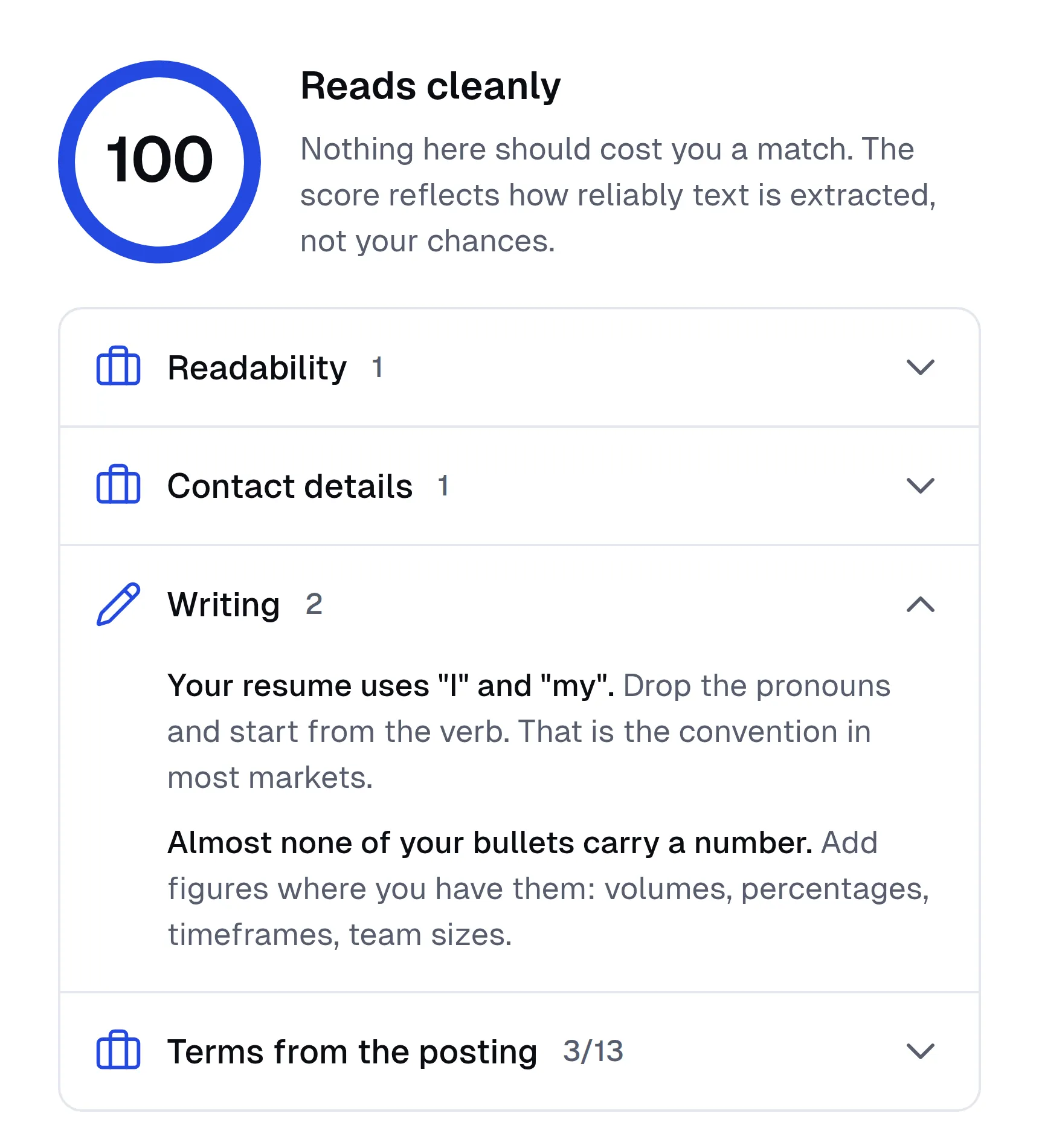
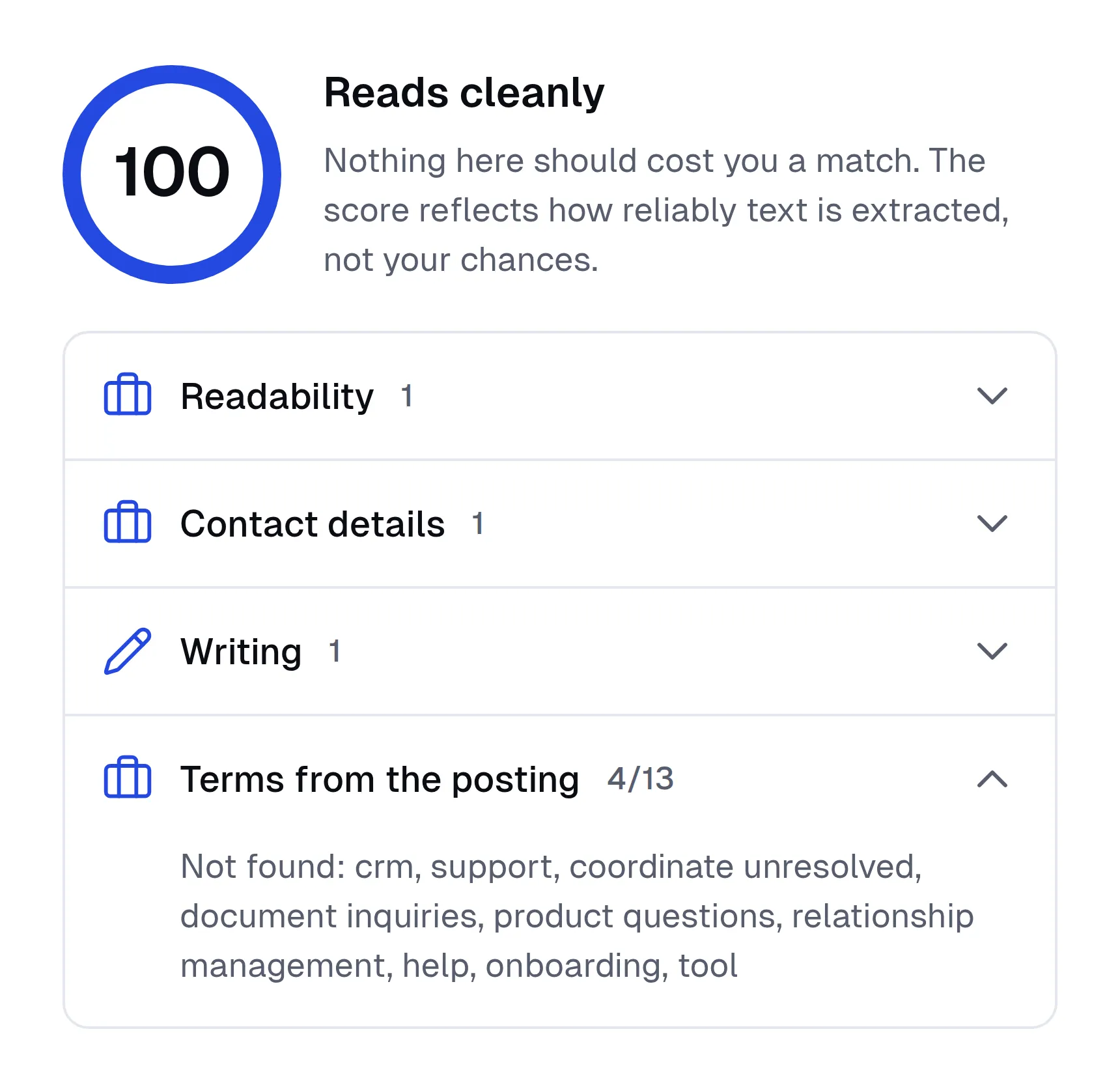
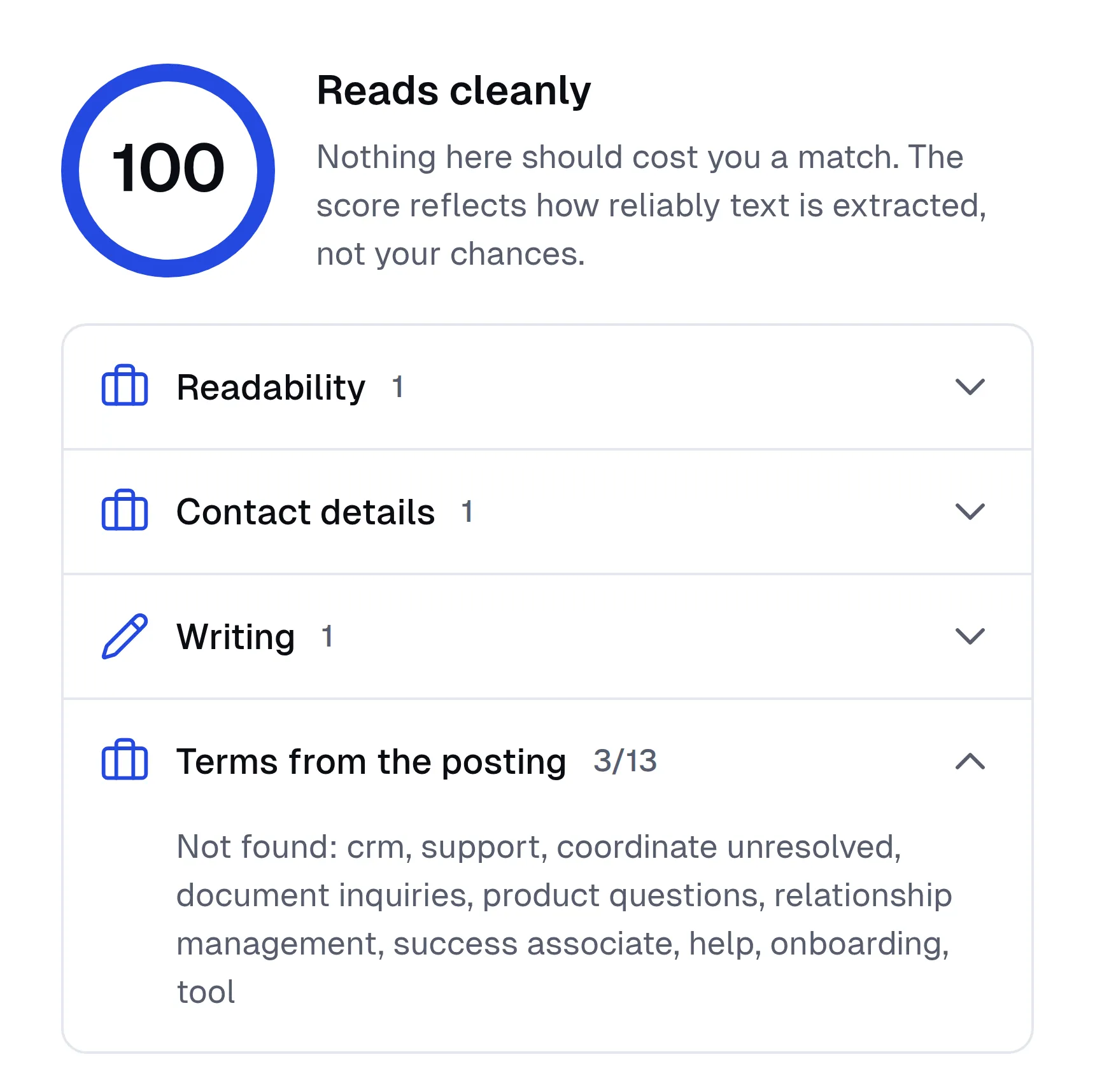
- All four scored 100 for readability. The checker read “Objective” as the opening section, so A and B got no missing-section note.
- A (generic objective): the only version with the note that the resume uses “I” and “my”. It matched 3 of the posting’s 13 terms.
- B (targeted objective): no pronoun note, and 4 of 13 terms. The extra one is the job title, “success associate”.
- C (skills summary): 3 of 13 terms, like A.
- D (no opening): a tip that there is no summary paragraph, and 3 of 13 terms.
No version matched “crm” or “onboarding”. Jordan has neither, so no opening claims them. All four also got the same three general notes, about accessibility tags, a profile link and numbers in the bullets.
These are our checker’s results, not how every ATS works, and the score measures readability, not hiring odds. Paste your own job ad and check yours.
What changed between the two objectives?
| From the generic version | To the targeted version | Why the change helps |
|---|---|---|
| “a challenging position” | “Customer Success Associate role” | Makes the target clear. |
| “use my skills” | “resolves customer inquiries” | Identifies a specific relevant task. |
| “grow my career” | “trains new staff” | Replaces a personal wish with experience. |
| No example of follow-through | “documents follow-ups for clear handoffs” | Connects the opening to a concrete work habit. |
The changes work because they clarify what Jordan has actually done. The objective is not a place to copy requirements the candidate has never met. If the job asks for CRM experience and you lack it, leave that claim out. Show a related skill only when you can explain the difference.
How to check the finished resume
An opening statement still needs to fit the rest of the document. Check that the job title, relevant skills, and experience bullets support one another.
You can run an ATS-style readability check on your resume and compare it against the posting. Review any extracted text and missing terms yourself. A term appearing in a document is not evidence that a recruiter will prefer it, and no ATS-style check can predict an interview.
For a separate test of how different PDF layouts are read, see our ATS-friendly resume checklist. This writing example does not make any claims about how an employer’s ATS would score Jordan.
More resume objective examples
These examples are fictional. Each one assumes the candidate has the experience described; replace every claim with your own evidence.
Student applying for an internship
Marketing student seeking a communications internship, bringing experience preparing event newsletters and editing copy for a campus organization.
New graduate applying for a first role
Recent accounting graduate seeking an accounts payable assistant role, with coursework in financial reporting and experience organizing expense records for a student organization.
Career changer
Hospitality supervisor pursuing an office coordinator role, bringing experience maintaining schedules, handling customer requests, and preparing shift handoffs.
Returning to work after a break
Administrative assistant returning to office support work, with prior experience scheduling appointments, maintaining records, and responding to client inquiries.
None of these examples needs an invented percentage or an exaggerated title. For advice about how much work history to keep, read our resume length guide.
What to put instead of an objective
If the opening would repeat what your experience already makes clear, skip it and lead with your most relevant Experience or, for a student, Education section. Our entry-level resume example shows how to build the rest of the page from coursework, projects and part-time work. You can also use a short Summary of qualifications or a focused Skills section when that helps a reader see your fit. Name skills you have actually used, and keep the detailed evidence in your experience bullets. Our hard skills guide shows how to word and prove them.
A summary emphasizes past work. A skills section organizes relevant abilities. Neither needs to name a future role. These alternatives make sense when an objective would add little information.
Mistakes that make objectives less useful
- Writing the same objective for every job. If it does not identify the kind of role you want, it probably needs editing or removal.
- Leading with what you want to receive. Training and advancement are reasonable goals, but the opening should first show your potential contribution.
- Copying qualifications you lack. A job posting is a guide to relevance, not permission to embellish.
- Repeating the entire resume. Two supported strengths are usually more useful than a dense collection of adjectives.
- Keeping an objective out of habit. If it adds nothing that your experience section does not already show, take it out.
- Using clichés or too much first-person language. Phrases such as “highly motivated” and “self-starter” do not show what you can do. Many US resume guides also prefer leaving out “I” and “my”; treat that as a writing convention, not a rule imposed by ATS software. Penn State Harrisburg advises against vague clichés.
You can also leave the space empty. A clear experience section is better than a vague opener.
Final objective checklist
If your career path is straightforward, you may not need an objective. If you are changing direction, a carefully targeted sentence can make that direction easier to understand. Explore more examples in the ResumeUnbox writing guides.
Common questions
Are resume objectives outdated?
Not universally. Some career centers still suggest them for first jobs and career changes, while others prefer a qualifications summary. Use an objective only when it adds useful context.
How long should a resume objective be?
Start with one or two concise sentences. Keep it short enough to fit naturally under your contact details without crowding your strongest experience.
Should I use a resume objective and a summary together?
Usually not. They compete for the same space. Choose the one that adds more information for the role, or skip both.