How long should a cover letter be? Words and pages, tested
How long should a cover letter be? Compare word counts and page layouts, cut a 547-word draft to 309, and copy a short version for text boxes.


The short answer: one page, with room to read
Princeton’s career center recommends approximately 250–400 words and no more than one page. Treat that as writing guidance, not a research finding about the word count that gets interviews. For a typical job application, organize your letter into three or four paragraphs: an opening, relevant evidence, and a short close.
Start with the employer’s instructions. A stated word, character, or page limit takes priority. If the form asks you to answer specific questions, make space for those answers before adding background about yourself.
Words versus pages: we tested the same letter
We created a fictional payroll specialist, Avery Rowan, with four years across two invented employers, applying to the fictional midsize manufacturer Bracken Vale Manufacturing. We shortened the same letter by deleting sentences. The facts, contact header, recipient, greeting, and sign-off stayed the same.
Test setup, November 10, 2026: ResumeUnbox’s live cover letter builder, linked to a new fictional resume. We used its default Onyx template, IBM Plex Serif body text at 10 pt, 1.5 line height, and “Normal” margins: 14 pt left/right and 12 pt top/bottom. We selected US Letter paper. These are the settings we tested, not recommended margins for every application.
The builder counted body words only. Its 309-word version contained 335 words across the full exported letter, including the contact header and other letter details. If you compare counts in another editor or a form, check what is included.
| Version | Body words | Font size | PDF pages | Last line at | Builder label |
|---|---|---|---|---|---|
| A: first draft | 547 | 10 pt | 1 | 89.0% | Getting long |
| B: first cut | 401 | 10 pt | 1 | 73.9% | Getting long |
| C: recommended edit | 309 | 10 pt | 1 | 62.5% | A comfortable length |
| D: shorter edit | 198 | 10 pt | 1 | 51.2% | A comfortable length |
| B: font check | 401 | 11 pt | 1 | 84.8% | Getting long |
| B: font check | 401 | 12 pt | 1 | 94.2% | Getting long |
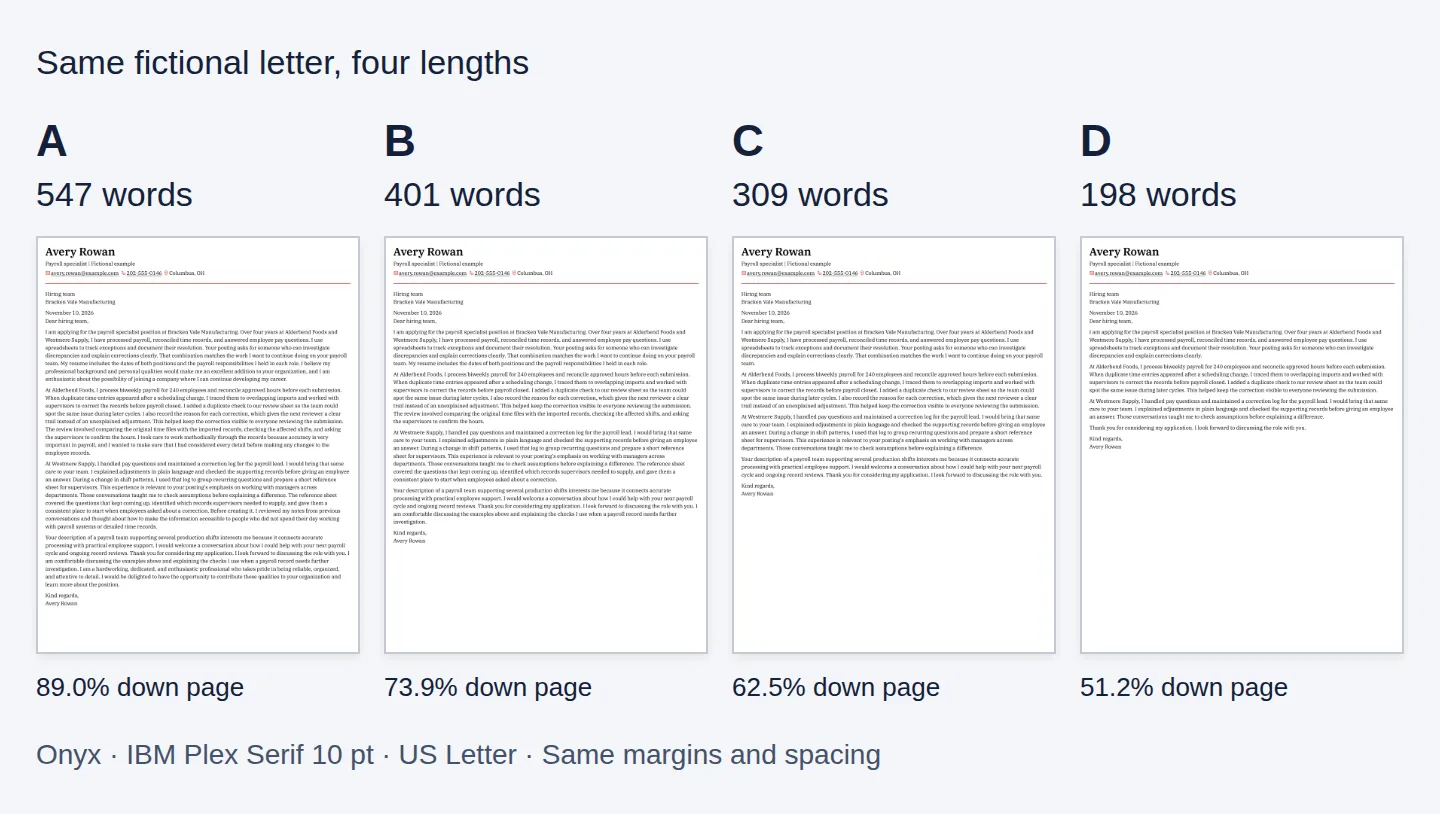
“Last line at” measures how far down the page the final text ends, including the sign-off. We divided the bottom of the last text block by the page height using PyMuPDF 2.1, then rounded to one decimal place. All six exports were one-page US Letter PDFs.
The result shows why a page limit alone cannot tell you when to stop writing. Version A fit, but it spent words repeating the resume and describing personal qualities without adding evidence. Version C kept both work examples and ended much higher on the page. These measurements describe this letter in this template only.
Font size and margins change the result
The 401-word letter ended at 73.9% of the page at 10 pt and 94.2% at 12 pt. We changed only the text-size control for those rows; it also scaled the name heading. A longer recipient address, different font, or wider margins would change the layout again.
Our default margins were much narrower than the one-inch margins in MIT’s cover letter guidance, which also recommends readable 10–12 pt type. Do not copy our narrow margins just to fit more words. Set a readable layout, cut the text, and inspect the actual exported PDF.
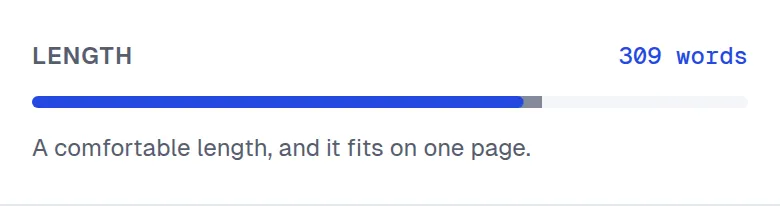
The builder’s shaded Length band covers 180–320 body words. That is the builder’s guide, not evidence of recruiter reading habits. Its message for C was “A comfortable length, and it fits on one page.” The longer versions still fit in this particular layout.
What to cut: from 547 words to 309
The edit removed 238 words without changing a fact. Here are the complete passages removed from each paragraph; the full surviving letter follows. All names, employers, and achievements in these samples are fictional.
Opening: 122 words to 70
Removed:
My resume includes the dates of both positions and the payroll responsibilities I held in each role. I believe my professional background and personal qualities would make me an excellent addition to your organization, and I am enthusiastic about the possibility of joining a company where I can continue developing my career.
Why: The resume already carries the work history. Generic enthusiasm takes space without explaining the fit; the remaining opening names the role and connects the applicant’s work to the posting.
Payroll example: 155 words to 95
Removed:
The review involved comparing the original time files with the imported records, checking the affected shifts, and asking the supervisors to confirm the hours. I took care to work methodically through the records because accuracy is very important in payroll, and I wanted to make sure that I had considered every detail before making any changes to the employee records.
Why: The paragraph already explains the duplicate entries, their cause, and the correction. Keep that evidence and the follow-up check; remove the repeated description of being careful.
Employee support example: 155 words to 89
Removed:
The reference sheet covered the questions that kept coming up, identified which records supervisors needed to supply, and gave them a consistent place to start when employees asked about a correction. Before creating it, I reviewed my notes from previous conversations and thought about how to make the information accessible to people who did not spend their day working with payroll systems or detailed time records.
Why: Keep the correction log and supervisor reference sheet. The deleted sentences repeat how the applicant organized information without adding another relevant result.
Closing: 115 words to 55
Removed:
I am comfortable discussing the examples above and explaining the checks I use when a payroll record needs further investigation. I am a hardworking, dedicated, and enthusiastic professional who takes pride in being reliable, organized, and attentive to detail. I would be delighted to have the opportunity to contribute these qualities to your organization and learn more about the position.
Why: The specific interest in the payroll team and the invitation to talk already do the closing’s work. Another promise to discuss the examples and a list of personal qualities add little.
The complete edited letter
This is version C: 309 body words, with the rest of the letter included below. Replace every fictional detail with your own accurate information. Keep an example only if you can explain what you did.
Avery Rowan
Payroll specialist | Fictional example
avery.rowan@example.com | 202-555-0146 | Columbus, OH

Hiring team
Bracken Vale Manufacturing
November 10, 2026

Dear hiring team,

I am applying for the payroll specialist position at Bracken Vale Manufacturing. Over four years at Alderbend Foods and Westmere Supply, I have processed payroll, reconciled time records, and answered employee pay questions. I use spreadsheets to track exceptions and document their resolution. Your posting asks for someone who can investigate discrepancies and explain corrections clearly. That combination matches the work I want to continue doing on your payroll team.

At Alderbend Foods, I process biweekly payroll for 240 employees and reconcile approved hours before each submission. When duplicate time entries appeared after a scheduling change, I traced them to overlapping imports and worked with supervisors to correct the records before payroll closed. I added a duplicate check to our review sheet so the team could spot the same issue during later cycles. I also record the reason for each correction, which gives the next reviewer a clear trail instead of an unexplained adjustment. This helped keep the correction visible to everyone reviewing the submission.

At Westmere Supply, I handled pay questions and maintained a correction log for the payroll lead. I would bring that same care to your team. I explained adjustments in plain language and checked the supporting records before giving an employee an answer. During a change in shift patterns, I used that log to group recurring questions and prepare a short reference sheet for supervisors. This experience is relevant to your posting's emphasis on working with managers across departments. Those conversations taught me to check assumptions before explaining a difference.

Your description of a payroll team supporting several production shifts interests me because it connects accurate processing with practical employee support. I would welcome a conversation about how I could help with your next payroll cycle and ongoing record reviews. Thank you for considering my application. I look forward to discussing the role with you.

Kind regards,
Avery RowanHow long should each paragraph be?
Use each paragraph for a different job. In our edited sample, the opening has 70 words, the evidence paragraphs have 95 and 89, and the closing has 55. Those are counts from this example, not targets you need to match.
An opening needs the role and your relevant fit. A middle paragraph needs enough context to make an example understandable. The close needs a reason for your interest and a next step. If a paragraph repeats another one’s point, combine them or cut the weaker passage.
Use the posting’s wording where it describes experience you actually have. Our guide to finding resume keywords shows how to separate relevant language from qualifications you should leave out.
Cover letter length by situation
Entry-level jobs and internships: Start with a relevant project, course assignment, volunteer role, or job example. You can finish below the common word range if you have answered the application and shown your fit. Do not pad a short work history to fill the page.
Experienced applicants: Choose the work most relevant to this role. More years of experience give you more examples to choose from; they do not require a paragraph for every employer.
Career changes: Give the reader enough context to understand the move, then show a transferable skill in action. If the letter explains your direction, decide whether a resume objective would add anything or repeat it.
Can a cover letter be two pages?
For a typical nonacademic application, edit toward one page unless the employer asks for more. Academic faculty applications can be different: Purdue OWL’s academic cover letter guide describes letters of roughly one and a half to two pages. Follow the position’s instructions and the conventions of your field.
A second page that contains only a closing or signature is a reason to revisit the draft. Remove repeated content first, then check paragraph spacing and page breaks.
Can it be too short?
A short letter is incomplete when it names the role but gives no reason to consider your application. Ask whether it identifies your fit, supports that fit with an example, and addresses the employer’s request.
Our 198-word version kept the payroll incident and a shorter employee-support example. It lost the supervisor reference sheet and the fuller explanation of interest in the company. That is a content tradeoff to consider, even though the builder called both versions comfortable.
Email and application text-box versions
A text box may need only the body. Follow its instructions and count the exact text you paste. If it has a character limit, spaces and line breaks can matter; use the form’s own counter when available.
For an email, decide whether the message itself is the letter or simply introduces an attachment. If no matching job is posted, use our letter of interest format for a page example and a shorter email. If you attach the full letter, a brief email can identify the position and the attached documents without repeating the whole letter.
Here is version E: 142 words and 916 characters, counting spaces and the six line-break characters between its four paragraphs. It contains only the body, with no greeting or signature. It is a fictional short example, not a universal target for email length.
I am applying for the payroll specialist position at Bracken Vale Manufacturing. Over four years at Alderbend Foods and Westmere Supply, I have processed payroll, reconciled time records, and answered employee pay questions. I use spreadsheets to track exceptions and document their resolution.

At Alderbend Foods, I process biweekly payroll for 240 employees and reconcile approved hours before each submission. When duplicate time entries appeared after a scheduling change, I traced them to overlapping imports and worked with supervisors to correct the records before payroll closed. I added a duplicate check to our review sheet so the team could spot the same issue in later cycles.

At Westmere Supply, I answered pay questions, explained adjustments in plain language, and kept a correction log for the payroll lead.

Thank you for considering my application. I look forward to discussing the role with you.
This shorter version keeps one detailed payroll example. Before using it as a model, add any requested information and check that your reason for applying is clear.
Send the right letter with the right resume
Your letter and resume can have different lengths. Our resume length guide compares versions of a resume, and this sample ATS-friendly resume gives you a complete example to adapt alongside your letter.
In the live app, we verified PDF and Word exports for the letter. We also downloaded the linked resume and letter as two separate PDFs with matching filenames. The Word option describes its layout as simplified, so review the format the employer actually requests.
Before applying, check the resume you send with it. The checker reads resumes; review the letter’s wording, page layout, and recipient details yourself.