Letter of interest format: how to write one, with an example
Use this letter of interest format: a filled-in sample with each part labeled, the same letter as an email, and lines for internships and teaching jobs.


Use this letter of interest format when you want to approach an employer that has no matching job posted. Start with your contact details and a named recipient, explain why this company interests you, support your fit with an example, and ask for a conversation. Below, you can copy a filled-in letter or its shorter email version.
Letter of interest format, part by part
This sample follows Mara Ellison, a fictional inventory analyst, writing to Rowan Vale, the fictional director of supply planning at Orchard Bend Foods. Every employer, company announcement and achievement in the example is invented. Use your own verified details when you adapt it.
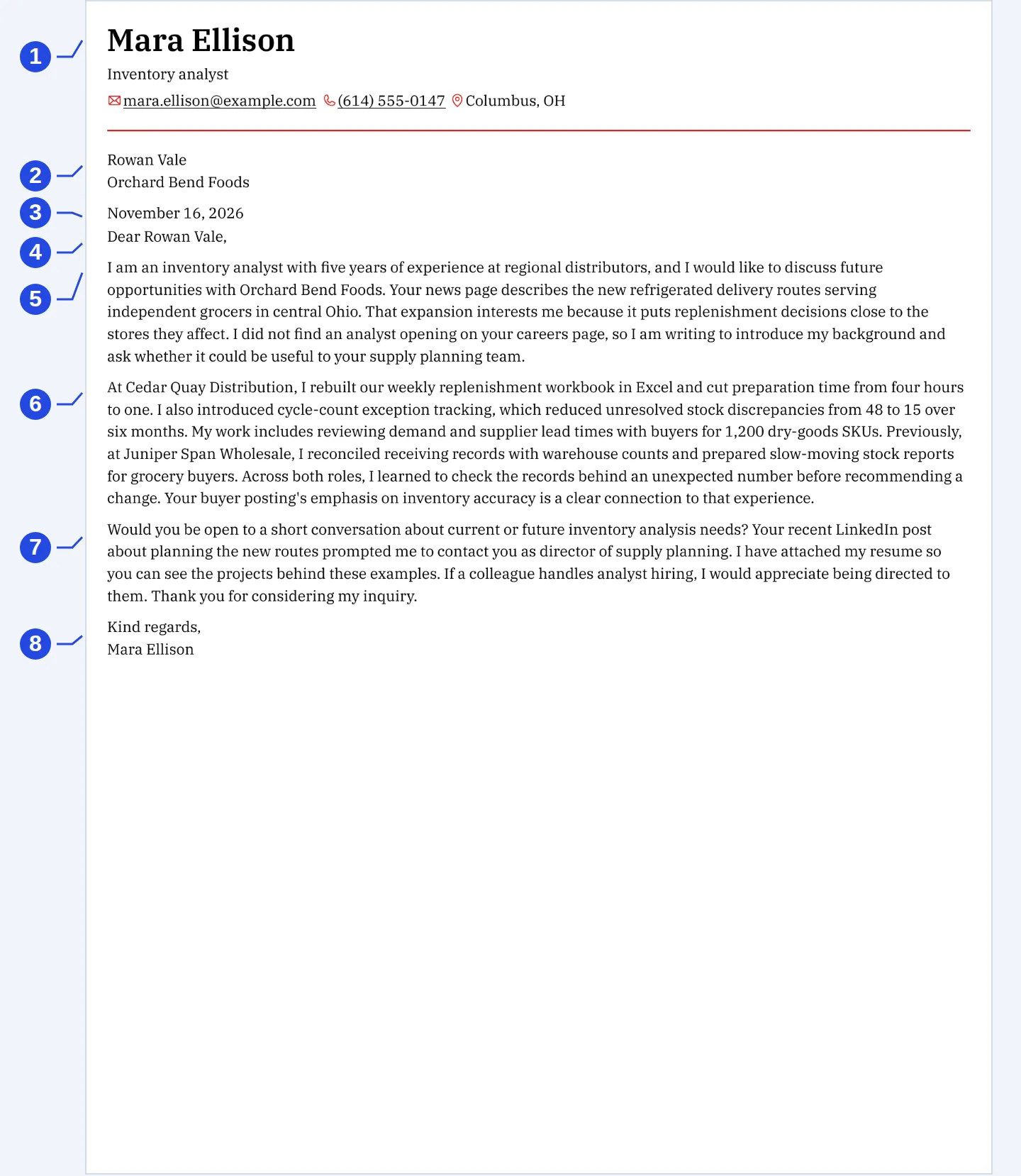
| Part | What to put there |
|---|---|
| 1. Contact header | Your name, email, phone and location. Match the resume you attach. |
| 2. Recipient | The contact’s name and company. Add their title and mailing address for a postal letter. |
| 3. Date | The date you finish the letter. |
| 4. Greeting | Address the person by name. If you cannot find one, name the relevant team. |
| 5. Opening | Your field, why you are writing and a specific reason for choosing this company. |
| 6. Value paragraph | Relevant work and results you can substantiate. |
| 7. Ask | A short conversation about current or future needs, plus a note that your resume is attached. |
| 8. Sign-off | A courteous closing and your name. |
For a traditional business letter, put the date before the recipient block, align the text left and separate paragraphs with blank lines. Purdue OWL’s business-letter guide explains those conventions. Our builder export places the recipient before the date; the numbered parts above follow that exported page.
What is a letter of interest?
A letter of interest introduces you to an employer when you have no matching advertised role to apply for. A cover letter normally answers a specific posting. That is the distinction in the University of Cincinnati’s guide. If you have a posting, use our guide to cover letter length and examples instead.
Names vary. Florida Gulf Coast University calls unsolicited outreach a letter of inquiry or prospecting letter, and Indeed also uses statement of interest. When an employer requests one of these documents for a posted job, follow its instructions. Academic letters of intent can mean something different: UVA’s medical-school guidance describes a commitment to attend if accepted.
A filled-in letter of interest you can adapt
Fictional sample. The complete letter below has 258 body words, excluding the contact details, recipient, date, greeting and sign-off. In our November 16, 2026 test, it exported as one US Letter page. These are measurements of this example, rather than a required word range.
Mara Ellison
Inventory analyst
mara.ellison@example.com
(614) 555-0147 | Columbus, OH

Rowan Vale
Orchard Bend Foods

November 16, 2026
Dear Rowan Vale,

I am an inventory analyst with five
years of experience at regional
distributors, and I would like to
discuss future opportunities with
Orchard Bend Foods. Your news page
describes the new refrigerated
delivery routes serving independent
grocers in central Ohio. That
expansion interests me because it
puts replenishment decisions close
to the stores they affect. I did not
find an analyst opening on your
careers page, so I am writing to
introduce my background and ask
whether it could be useful to your
supply planning team.

At Cedar Quay Distribution, I
rebuilt our weekly replenishment
workbook in Excel and cut
preparation time from four hours to
one. I also introduced cycle-count
exception tracking, which reduced
unresolved stock discrepancies from
48 to 15 over six months. My work
includes reviewing demand and
supplier lead times with buyers for
1,200 dry-goods SKUs. Previously, at
Juniper Span Wholesale, I reconciled
receiving records with warehouse
counts and prepared slow-moving
stock reports for grocery buyers.
Across both roles, I learned to
check the records behind an
unexpected number before
recommending a change. Your buyer
posting's emphasis on inventory
accuracy is a clear connection to
that experience.

Would you be open to a short
conversation about current or future
inventory analysis needs? Your
recent LinkedIn post about planning
the new routes prompted me to
contact you as director of supply
planning. I have attached my resume
so you can see the projects behind
these examples. If a colleague
handles analyst hiring, I would
appreciate being directed to them.
Thank you for considering my
inquiry.

Kind regards,
Mara Ellison
How we laid out the page
In the live ResumeUnbox app, we created Mara’s one-page resume, then chose Documents → New → New cover letter instead. We left the application unlinked, selected her resume under From, and entered Rowan’s name, company and the date under To.
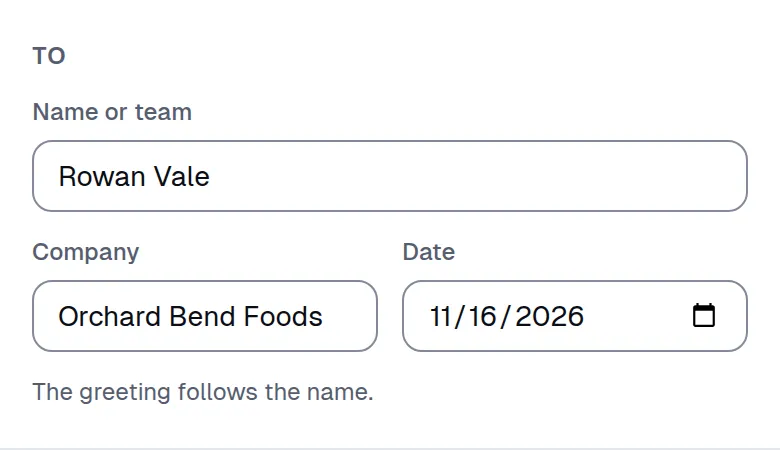
The letter initially matched the resume’s design. We turned matching off to inspect the controls, keeping the inherited Onyx template, IBM Plex Serif, 10 pt body text, 14 pt headings, 1.5 line height, and Normal margins: 14 pt horizontally and 12 pt vertically. Paper was Letter. Those small margins are the tested defaults, not a recommendation to squeeze your letter onto a page.
The PDF printed Mara’s name, headline, email, phone and city, followed by the recipient, company and date. The structured form had no separate recipient title, company street-address or subject-line field. For a mailed letter, add the full address block in a document editor. Write an email subject in your email app.
Typing “Rowan Vale” produced “Dear Rowan,” automatically. We changed it to “Dear Rowan Vale,” and kept the default “Kind regards,” followed by Mara’s name. The Length panel showed 258 words and “A comfortable length, and it fits on one page.” We downloaded both PDF and Word; the Word option describes its layout as simplified.
We also tried Draft from your resume once without an application. Its 235-word AI draft used the resume’s results but gave no specific reason for choosing Orchard Bend Foods. It claimed to be applying for an inventory analyst role, although we had supplied no opening. The letter above was written separately. Review generated text and remove claims you cannot support; the draft controls let us keep or discard it.
How to write a letter of interest
Find a reason to contact this employer. Read its news page and current work. Note one detail that connects to something you can do. A real expansion or project gives you more to discuss than a sentence about admiring the company.
Find the right contact. Look for the person responsible for the team you could join, or use the company’s stated inquiry channel. Check their current role and spelling. FGCU notes that some employers do not accept unsolicited letters and resumes, so respect any instructions on its careers page.
Choose evidence from your resume. Mara’s workbook and stock-count examples support her interest in inventory analysis. You can show a useful result without a percentage: explain what you changed and who used it. Use the company’s wording where it accurately describes your work; our resume keywords guide shows how to make that choice honestly.
Connect your background to the work. If you are changing careers, explain the connection in the letter. You may then need less explanation in a resume objective.
Turn template lines into specific details
These are generic template prompts beside lines from our fictional letter. The research notes are invented source scenarios, not real pages or claims about an employer.
| Template prompt | Filled line from the sample | What to check in your own research |
|---|---|---|
| “I admire [company project].” | “Your news page describes the new refrigerated delivery routes serving independent grocers in central Ohio.” | The fictional news announcement supplies a concrete project and location. Find an equivalent fact on the real company’s site. |
| “My skills fit [company priority].” | “Your buyer posting’s emphasis on inventory accuracy is a clear connection to that experience.” | A fictional posting for another team suggests relevant language; it does not establish an analyst vacancy. |
| “I achieved [relevant result].” | “At Cedar Quay Distribution, I rebuilt our weekly replenishment workbook in Excel and cut preparation time from four hours to one.” | Mara’s fictional resume supplies the result. Use records you can substantiate, not a number from someone else’s sample. |
| “I am contacting [appropriate person].” | “Your recent LinkedIn post about planning the new routes prompted me to contact you as director of supply planning.” | A fictional professional post identifies the contact’s work. Verify both the person’s role and the post before referring to them. |
Keep it to a readable page and attach your resume
Aim for one page for this kind of introduction. UW–River Falls Career Services recommends a one-page business-letter layout for application correspondence. Our 258-word sample fits, but your header, font and spacing will change the result. Inspect the export to confirm how many pages your own letter uses.
Attach an up-to-date resume with relevant experience easy to find. This sample ATS-friendly resume shows a complete example to adapt. Before sending, check the resume you attach. The checker reads resumes; review the letter’s wording and layout yourself.
The same letter as an email
Put the greeting first and move your contact details to the signature. An email does not need the postal address block. Choose a subject that identifies the kind of work you want to discuss:
- Inventory analysis opportunities at Orchard Bend Foods
- Letter of interest: Mara Ellison, inventory analyst
This fictional version has 127 body words and 807 characters, including spaces and line breaks, with a blank line between its three paragraphs. The complete block, including greeting and signature, is 141 words and 922 characters. Both counts exclude the subject; they describe this example, not an email limit. Replace the LinkedIn placeholder with your profile or remove that line.
Dear Rowan Vale,

I am an inventory analyst with five
years at regional distributors.
Orchard Bend Foods' new refrigerated
routes for independent grocers in
central Ohio caught my attention. I
did not see an analyst opening, but
I would welcome a conversation about
future needs on your supply planning
team.

At Cedar Quay Distribution, I
rebuilt our Excel replenishment
workbook and cut weekly preparation
from four hours to one. My
cycle-count tracking also reduced
unresolved stock discrepancies from
48 to 15 over six months.
Previously, I prepared slow-moving
stock reports for grocery buyers at
Juniper Span Wholesale.

Could we arrange a short
conversation about where this
experience might fit? I have
attached my resume. If a colleague
handles analyst hiring, I would
appreciate a referral. Thank you for
your time.

Kind regards,
Mara Ellison
(614) 555-0147
mara.ellison@example.com
LinkedIn: [your profile URL]
Use the message as the letter and attach your resume. If the employer asks for a separate letter file, follow that request and write a brief email introducing the attachments.
How to end a letter of interest
Make your next step easy to answer. Choose one closing that suits the situation, then add a sign-off and your name. These fictional lines are alternatives, not paragraphs to stack together:
Would you be open to a short
conversation about current or future
inventory analysis needs?

Could you point me to the person who
handles internship inquiries?

If a suitable opening comes up, I
would appreciate hearing which
application channel I should use.
If you receive no reply, you could send one brief follow-up after about two weeks. That is an example cadence suggested by Cincinnati’s guide, not an employer response deadline. Keep the original message in the thread, restate your interest, and follow any request not to contact the team again.
Short examples for an internship, teaching or an internal move
Each fictional pair below gives you an opening and an ask. Add evidence from your own studies or work between them. If a role is advertised, use the application process and address its requirements.
Letter of interest example for an internship
Opening: I am a supply chain student
interested in how Orchard Bend Foods
plans deliveries for independent
grocers. My class project compared
reorder schedules for a fictional
grocery store.

Ask: Would your planning team
consider an intern for a future
term, or could you direct me to your
internship contact?
Teaching letter of interest sample lines
Opening: I am an elementary teacher
interested in Alder Fen School
District's family reading workshops.
In my current classroom, I run
reading conferences and share
practice activities with families.

Ask: Could we discuss future
elementary vacancies and the
district's application process?
Letter of interest for an internal position
Opening: I work in receiving at
Cedar Quay Distribution and would
like to explore a future move into
inventory analysis. My weekly
discrepancy reviews have given me
experience tracing differences
between receipts and stock counts.

Ask: Would you be available to
discuss the skills your team needs
and the internal transfer process?