If a posting specifically requires a former supervisor, pick someone who fits that description. If you cannot, ask whether a project lead or instructor is an acceptable substitute.
Resume writing Guide
References on a resume: when to list them and how
Should you put references on a resume? Learn when employers want them, how to format a separate reference page, and what to check before applying.

Daniel Brooks Recruitment & Hiring Editor

For most US job applications, references do not belong on your resume. Keep a separate reference list ready and send it when an employer asks. Here’s how to choose people, format the page and handle the occasional application that requests references upfront.
Should you put references on a resume?
Usually, no. The University of Pennsylvania’s resume guidance recommends saving references until they are requested, often after an interview. Your experience and skills are better uses of resume space. Some employers request references earlier, so the application instructions always come first.
| What the employer says | What you should do |
|---|---|
| It says nothing about references | Send a resume without a References section. Have a separate list ready. |
| It asks for a reference list or separate upload | Send a standalone reference page using the requested fields and format. |
| It specifically asks for references on your resume | Add a short References section to the resume file. |
| It provides reference fields in an application form | Complete those fields rather than adding names to an unrelated document. |
A request for references is not always a request to put them inside your resume. Purdue OWL explains that employers may ask through an application, a separate attachment or around an interview. Follow the exact request.
If you need to decide what else belongs on the page, see our guide to resume sections and their order.
Who should you use as a professional reference?
Choose someone who has seen your work or learning firsthand. A former manager can describe your responsibilities. A coworker can speak about a project you completed together. If you are new to work, an internship supervisor, instructor or volunteer coordinator may know your skills better than anyone in an office.
For a fictional office coordinator called Maya Rivera, a sensible shortlist might include:
- A former team lead who supervised Maya’s scheduling and records work.
- A colleague who worked alongside Maya on customer requests.
- A volunteer program lead who saw Maya organize events.
The most senior person you know is not automatically the best reference. Choose someone who can give specific examples, is willing to speak and is likely to respond. Purdue’s job application worksheet also recommends using people who know your work rather than family members.
Tip
How many references should you prepare?
Three is a useful starting point, not a rule for every employer. Purdue’s worksheet suggests at least three references. An employer might request a different number or a specific type of relationship; follow that request instead.
It helps to keep a backup contact in mind. People move, take leave or become hard to reach. Choose those who can speak to the role you are applying for and confirm their availability before you share their details.
Ask for permission before listing anyone
Send a short message to each potential reference before giving an employer their contact information. Tell them what kind of role you are applying for, why you thought of them and which parts of your work they may be asked about. Purdue’s reference-request guidance specifically recommends checking in first and sharing your current resume.
For Maya’s fictional former team lead, a request might read:
Hi Elena, I’m applying for an office coordinator role. Would you be comfortable serving as a professional reference? We worked together on scheduling and customer requests at North Gate Services. If you’re happy to help, I’ll send the posting and my current resume. Let me know which email or phone number you prefer me to share.
Illustrative message and fictional workplace.
When the person says yes, check their preferred title, organization and contact method. Tell them when you actually pass their information to an employer. Do not assume that an old work email or personal number is still appropriate.
A full reference page example
Keep your reference sheet as a separate document with the same applicant name, email and phone number used on your resume. Give it a clear heading, then list each reference consistently: name, role, organization, contact details and relationship to you. You can omit postal addresses unless an employer requests them.
Here is a complete fictional example. Maya, Elena, Jonah, Tessa, their workplaces and all their details are invented. The email addresses use example.com; the telephone numbers use the North American Numbering Plan Administrator’s reserved fictional range.
MAYA RIVERA
Washington, DC | maya.rivera@example.com | (202) 555-0142

PROFESSIONAL REFERENCES

Elena Park
Former Operations Team Lead | North Gate Services (fictional)
elena.park@example.com | (202) 555-0167
Relationship: Supervised Maya's scheduling and records work.

Jonah Reed
Former Project Coordinator | North Gate Services (fictional)
jonah.reed@example.com | (202) 555-0181
Relationship: Worked with Maya on service-desk improvements.

Tessa Wu
Volunteer Program Lead | Riverbend Community Program (fictional)
tessa.wu@example.com | (202) 555-0139
Relationship: Coordinated events with Maya.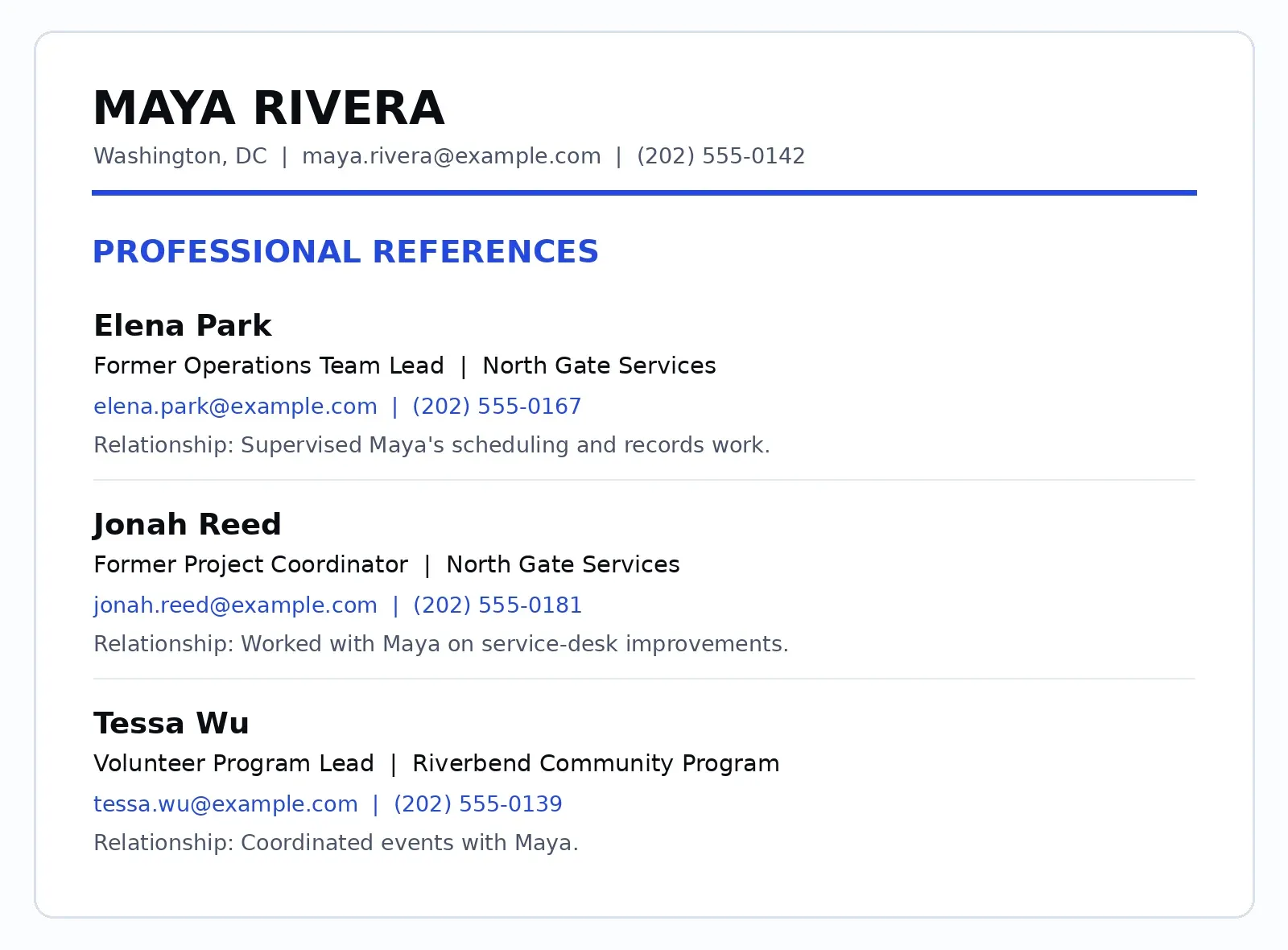
Use the same contact header as your resume, not your reference’s contact details in the main header. Save the file under a clear name, such as Maya-Rivera-References.pdf, and send it only when asked. Our resume length guide can help you keep the main resume focused on relevant experience.
If the posting explicitly wants references on the resume
Add a labeled section at the end of your resume, below your relevant experience, education and skills. Include only the contact fields requested. In Maya’s illustrative resume, the short section could be:
REFERENCES
Elena Park | Former Operations Team Lead, North Gate Services
elena.park@example.com | (202) 555-0167

Jonah Reed | Former Project Coordinator, North Gate Services
jonah.reed@example.com | (202) 555-0181
All entries above are fictional. If the employer needs more names, add more approved contacts. If it asks for a separate reference page, use the full sheet instead.
What happens when you add references to the resume PDF?
Extra contacts appear in the file alongside the applicant’s details. We built Maya’s fictional resume in the ResumeUnbox editor and exported two PDFs: one without references and one with the two-entry References section above. On November 3, 2026 we ran both through the ResumeUnbox ATS-style checker, without a job posting.
- Without references: score 100. Under Contact details, the only note was a missing profile link.
- With references: also 100, plus a new note: “More than one email address appears. Keep a single address, so software does not have to guess which one to use.” The extracted text listed Elena’s and Jonah’s emails and phone numbers at the end, after Maya’s own details. The checker raised no note about the extra phone numbers.
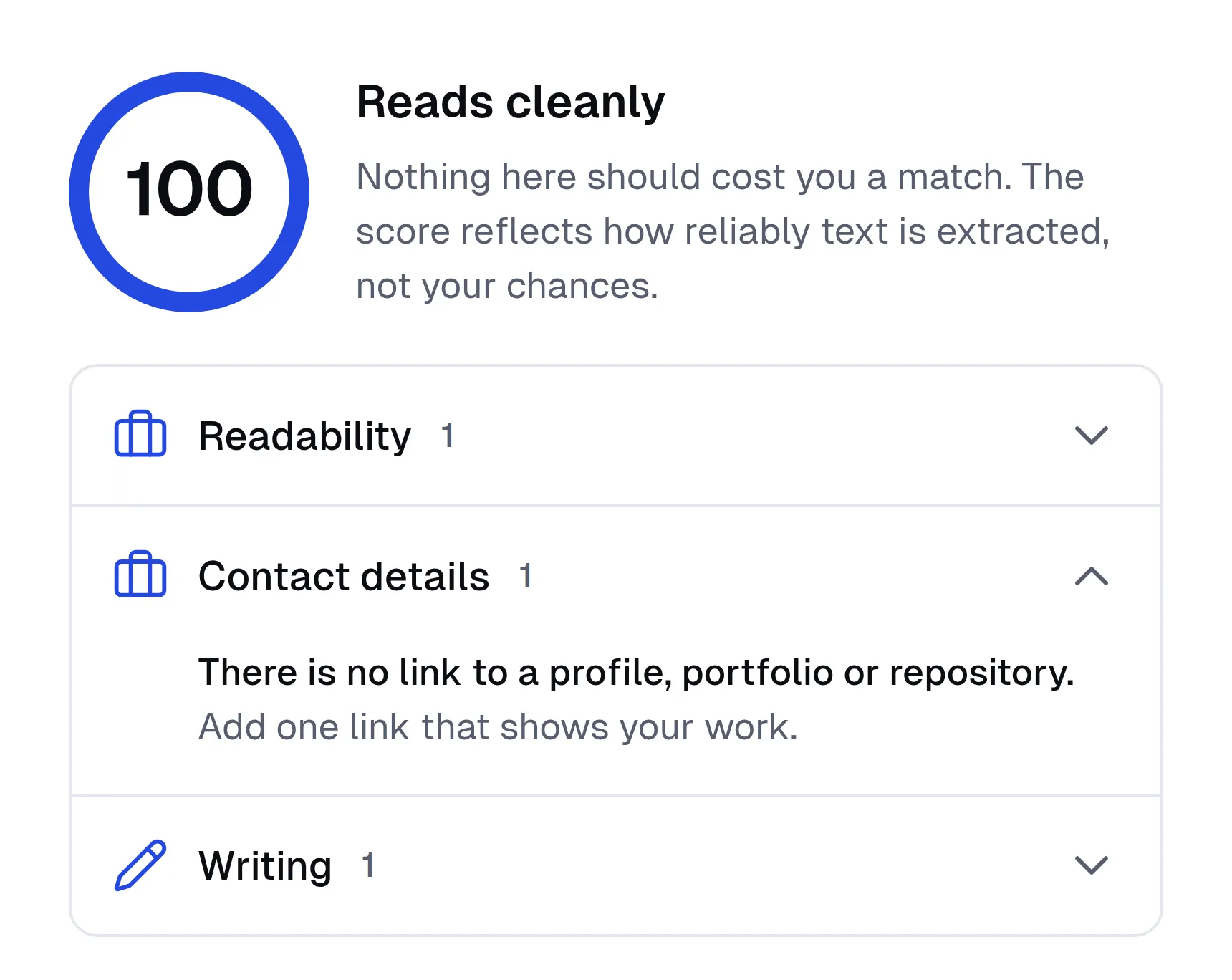
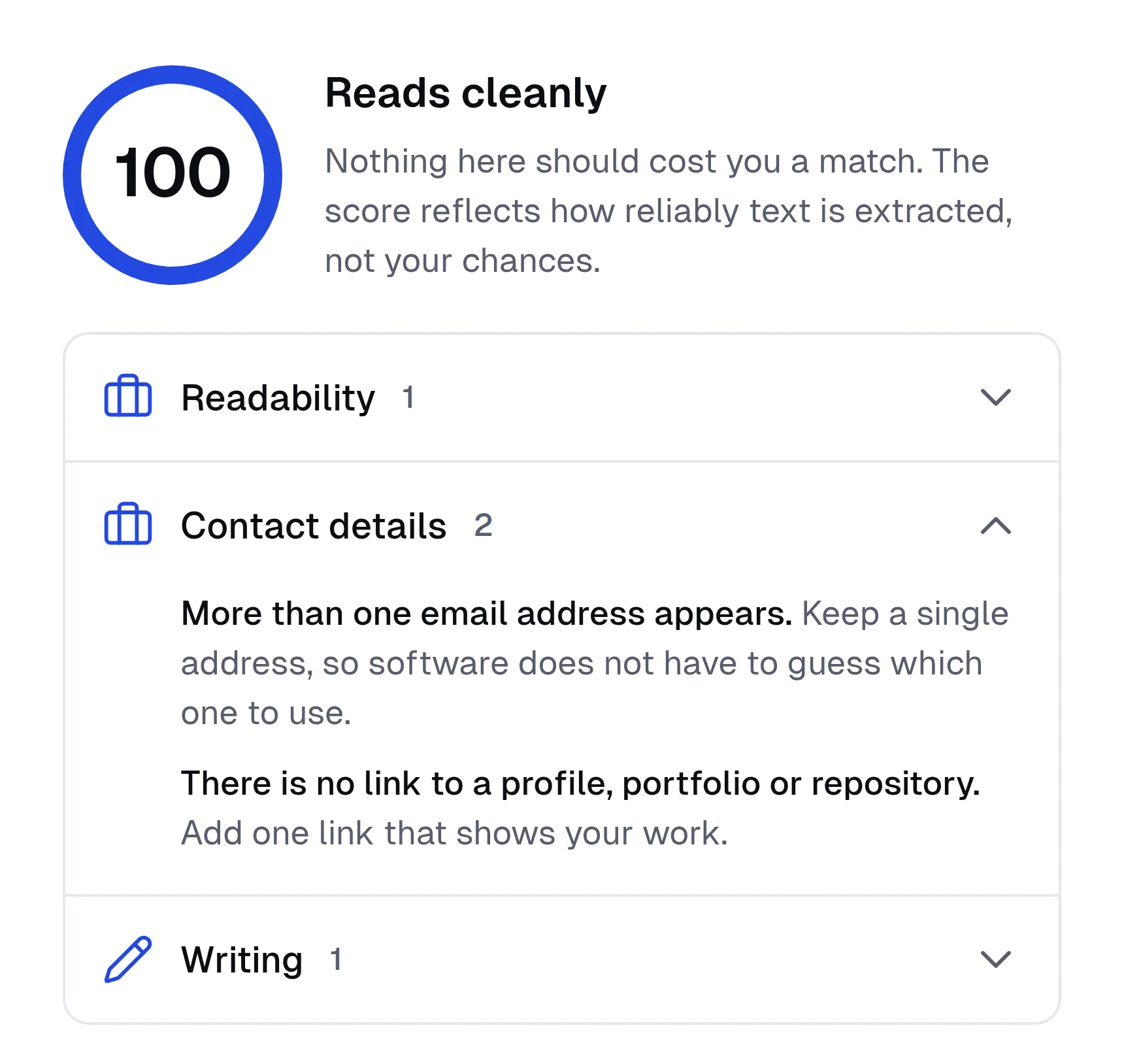
This shows what our checker reads, not what an employer’s applicant tracking system does. It does not establish which details a real ATS assigns to the candidate or how any employer makes hiring decisions.
For your own file, use the ResumeUnbox ATS-style checker to inspect the text and contact details it reads. Compare the version without references with the version your employer requests. Make sure your name, email and phone remain clearly labeled, and do not take a readability result as a promise about interviews. Our ATS-friendly resume comparison explains what this kind of test can and cannot establish.
Mistakes to avoid
Adding “References available upon request.” In most applications you can leave this line out. The employer can ask for references when needed, and the line takes space without telling the reader more about your qualifications.
Sharing someone’s private details without asking. The person should know which contact information will be passed to an employer and what job you are pursuing.
Choosing someone who cannot describe your work. A manager who barely remembers you may be less helpful than a collaborator who can discuss a specific project.
Using a separate sheet when the form asks for fields. Follow the form. A well-formatted PDF does not replace required application fields.
Forgetting to check old details. A contact may have changed employers or email addresses. Verify their information again before sharing it.
Reference checklist
Questions about references
Should I write references available upon request on my resume?
Usually not. Keep the list ready and share it when the employer requests it. Follow different instructions if they appear in the posting.
Can I use a friend as a reference?
Someone who can speak to your work on a project or volunteer activity may be useful. A friend who only knows you socially is usually not a strong professional reference. Clarify the required relationship with the employer when necessary.
What if I have no previous employer?
Consider an instructor, internship supervisor, volunteer coordinator or project lead who has seen your work. Explain the real relationship and do not invent a job or supervisor.
How old can a reference be?
Someone you worked with years ago can still be useful if they remember your work and are willing to speak. Prioritize relevance, availability and any recency requirement the employer states.