When a credential is mandatory, put it where the reader sees it early. When it simply supports work experience, let that experience carry more weight.
Resume writing Guide
How to list certifications on a resume (with examples)
Where certifications go on a resume, how to write each entry, and what to do with in-progress, expired or online course certificates. Full example inside.

Emma Carter Resume & Career Writing Editor

Not sure how to list certifications on a resume? Start with qualifications the job actually asks for, use their official names, and put the important ones where an employer can find them. The before-and-after example below shows how to make a credential clear without cluttering the page.
Which credentials should go on your resume?
A professional certification, an occupational license and a course-completion certificate can all matter, but they are different. As the US Bureau of Labor Statistics explains, professional certifications generally attest to assessed knowledge or skill, while occupational licenses provide legal authorization for certain work. Completing a class or educational program does not automatically confer an occupational license.
- Professional certification: A certifying organization confirms that you have met its requirements, often including an exam. Example: Project Management Professional (PMP), awarded by PMI.
- Occupational license: A government agency authorizes you to perform regulated work. Example: a state registered nurse license.
- Course-completion certificate: A training provider confirms that you finished a program. Example: Google Project Management Certificate.
The distinction can affect whether you meet a role’s requirements. The BLS registered nurse guide states that registered nurses need a state nursing license. Certain positions also require basic life support (BLS) or advanced cardiac life support (ACLS) certification. Check each posting for the precise credential and status it requires.
Include an optional course only if it helps explain a skill you can use in the job. A short list of relevant qualifications is more informative than a catalogue of unrelated webinars.
Where to put certifications on a resume
Start with the section that fits the credential’s importance.
- Required license: Place a Licenses and certifications section immediately below your summary.
- Relevant professional certification: Use a Certifications section after your summary or experience.
- Career-change training: Place Education and training near the top when it explains your new direction.
- Optional online course: Put it in Professional development, usually after experience.
You may mention a major certification briefly in your summary, then give full details in one dedicated section. Avoid repeating a long list. Our guide to resume sections shows how the entire resume can be ordered.
How to format a certification entry
A clear entry gives the credential’s full official name, the awarding organization and the dates or current status the reader needs.
Full credential name (acronym) — Issuing organization | Awarded: month and year | Expiration, when applicable
For example, here is a fictional PMP holder’s entry:
Project Management Professional (PMP) — Project Management Institute | Awarded May 2024 | Active
The person and award date are illustrative. Your resume must use your real status. According to PMI’s maintenance guidance, PMP holders must earn 60 professional development units in each three-year renewal cycle. You need not explain those renewal rules in the resume, but you should not claim an expired or suspended credential is active.
An issuer may offer a public verification link. PMI’s certification registry lets people search for holders, but holders may opt out. If you include a link, make sure it is an official, useful destination. Never publish a private account number in place of a public credential identifier.
Should you spell out the acronym?
Write Project Management Professional (PMP) when both the full name and acronym fit. A person familiar with either wording can recognize it. Use the official wording from the issuer, and make it clear to the person reading your resume.
Certification examples by field
These entries show how someone might list a credential they genuinely hold. The names and issuers are real; all holders and award dates below are fictional.
- IT: AWS Certified Cloud Practitioner — Amazon Web Services | Earned January 2025 | Active. See AWS’s credential description.
- Healthcare: Basic Life Support (BLS) Provider — American Heart Association | Completed April 2025 | Renew by April 2027. AHA awards a BLS course-completion eCard, not a nursing license. Verify your own card’s dates.
- Project management: Project Management Professional (PMP) — Project Management Institute | Earned May 2024 | Active. Check the real holder’s renewal status using PMI’s guidance.
- Entry level: Google Project Management Certificate — Google | Completed September 2025. This is course completion, not a PMP designation.
If you have a different credential, copy the structure, not these fictional dates or statuses.
Full worked example: before and after
Maya Torres is a fictional project coordinator applying for a fictional operations project role. The invented posting asks for vendor coordination, scheduling, status reports and budget tracking, and prefers Project Management Professional (PMP). Maya holds an active PMP and has completed the Google Project Management Certificate in this example. The employer, job history, dates and holder are made up solely to explain the formatting.
Before: a credential buried in skills
MAYA TORRES
Chicago, IL |
maya.torres@example.com |
(312) 555-0126

SUMMARY
Project coordinator with experience
in operations
and stakeholder communication.

EXPERIENCE
Project Coordinator | Northstar
Services | Chicago, IL
Mar 2022–Present
- Coordinated rollout schedules and
  vendor updates for 14 office
  sites.
- Prepared weekly project status
  reports for operations managers.
- Tracked spending against an
  approved project budget and
  flagged variances to the project
  lead.
- Kept the project risk log and
  meeting notes current for a
  six-person team.

Operations Assistant | Northstar
Services | Chicago, IL
Jun 2020–Feb 2022
- Maintained shared task logs and
  meeting notes for the operations
  team.
- Scheduled vendor visits and
  confirmed completed work orders
  with site managers.
- Updated purchase records in Excel
  for monthly cost reporting.

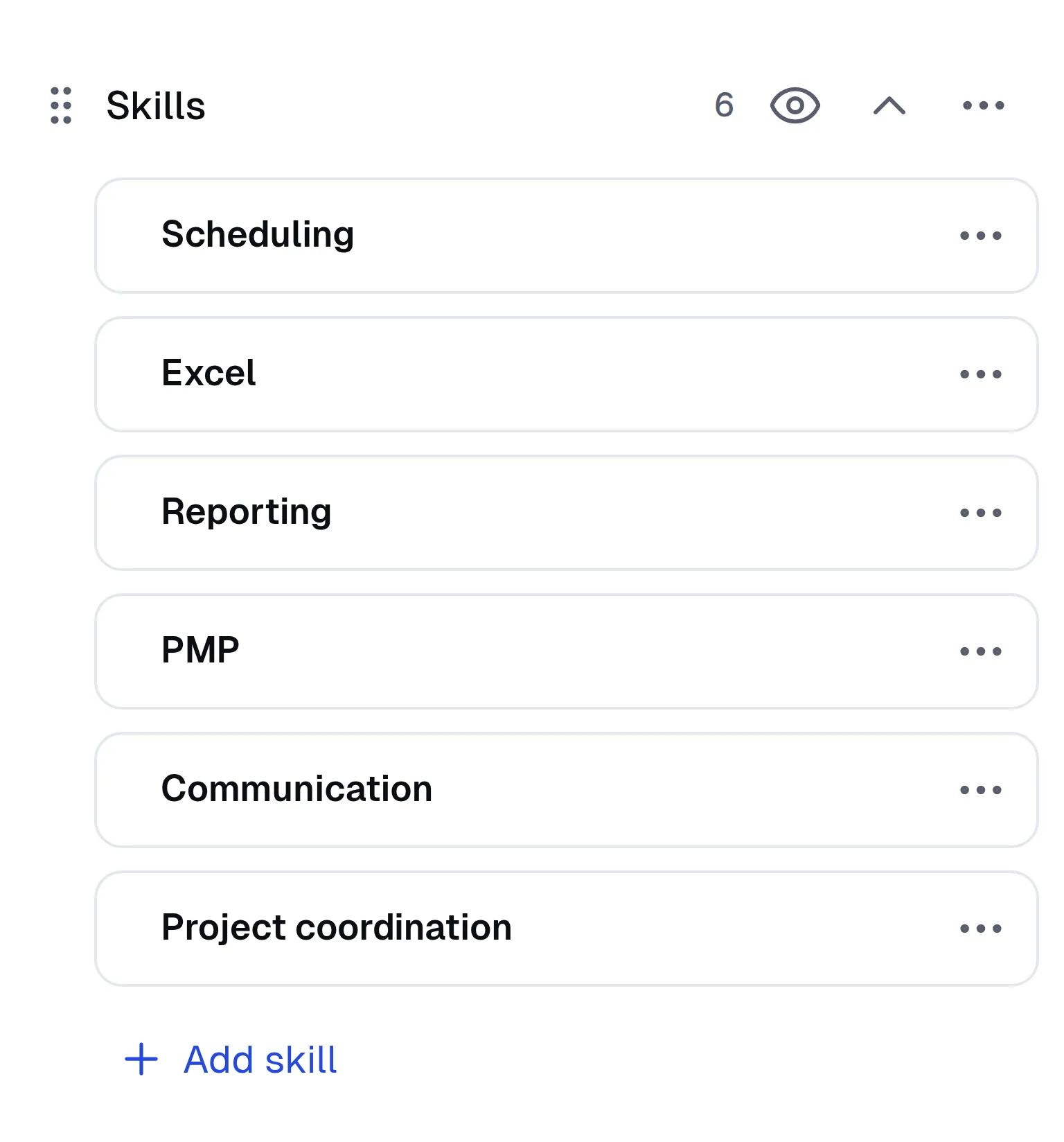
SKILLS
Scheduling, Excel, reporting, PMP,
communication, project coordination

EDUCATION
BA, Business Administration |
Lakeview State College | 2020
Here PMP is mixed with ordinary skills. Its full name, issuer and status are missing. A recruiter reading it quickly may not know whether Maya actually holds the certification. The relevant Google certificate has also been omitted.
After: the certification has its own place
MAYA TORRES
Chicago, IL |
maya.torres@example.com |
(312) 555-0126

SUMMARY
Project coordinator with four years
at a facilities services company,
supporting site rollouts, vendor
coordination, weekly status
reporting and budget tracking.

CERTIFICATIONS
Project Management Professional
(PMP) | May 2024
Project Management Institute
Active

EXPERIENCE
Project Coordinator | Northstar
Services | Chicago, IL
Mar 2022–Present
- Coordinated rollout schedules and
  vendor updates for 14 office
  sites.
- Prepared weekly project status
  reports for operations managers.
- Tracked spending against an
  approved project budget and
  flagged variances to the project
  lead.
- Kept the project risk log and
  meeting notes current for a
  six-person team.

Operations Assistant | Northstar
Services | Chicago, IL
Jun 2020–Feb 2022
- Maintained shared task logs and
  meeting notes for the operations
  team.
- Scheduled vendor visits and
  confirmed completed work orders
  with site managers.
- Updated purchase records in Excel
  for monthly cost reporting.

EDUCATION AND TRAINING
BA, Business Administration |
Lakeview State College | 2020
Google Project Management
Certificate | Google | 2022

SKILLS
Scheduling, vendor coordination,
status reporting,
budget tracking, Microsoft Excel
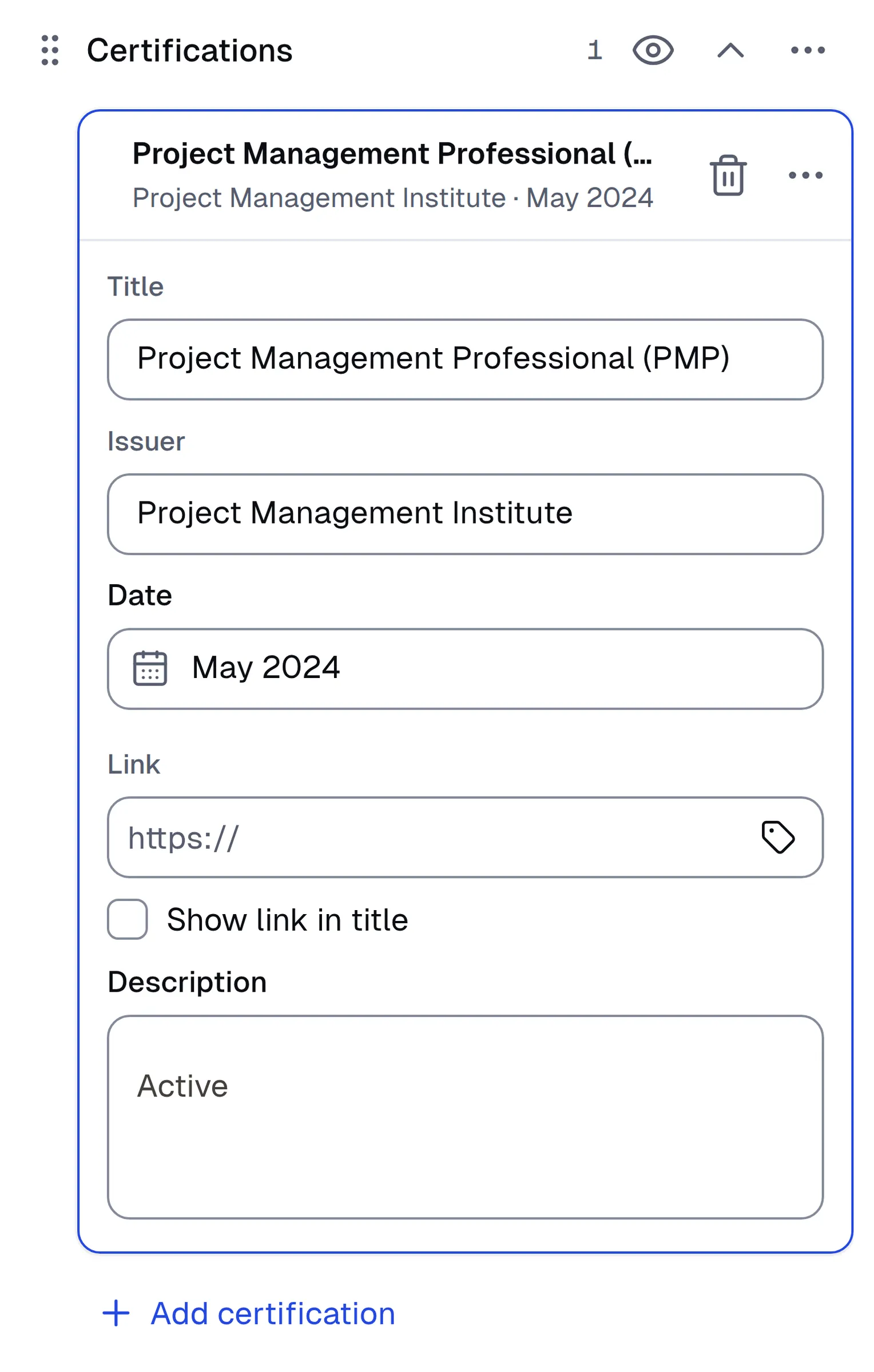
Maya’s PMP now has its full name and issuer. Her Google certificate is shown as training rather than as a license. The experience bullets stay intact; the improvement does not invent achievements. For guidance on proving technical abilities in those bullets, see how to list hard skills on your resume.
The Google Project Management Certificate is training developed by Google. Google says that completing it provides education hours toward eligibility for PMI’s Certified Associate in Project Management (CAPM) qualification. It does not by itself award CAPM or PMP. List the actual credential you completed.
Tip
What about unfinished, expired and online credentials?
In progress. Do not describe a professional certification as earned before you satisfy its requirements. If you are preparing for an exam and that work matters to the role, you can say PMP exam preparation — in progress under Professional development, provided it is true. Include an expected exam date only if it is genuinely scheduled. Do not add a designation after your name until you are authorized to use it.
Expired or suspended. Follow the issuing organization’s rules. Do not describe an inactive credential as active or imply it meets a current licensing requirement. You may describe relevant historical training when appropriate and permitted, but label it so the status is unmistakable.
Online courses. Name the actual course and awarding organization, with a completion date if it helps. A course from Coursera or Udemy may demonstrate relevant learning; it is not automatically the same kind of qualification as a license or an independently assessed certification.
No verification number. You can still list a genuine qualification. Do not invent a credential ID, and avoid putting private identifiers into a public resume.
Check that your certification text is readable
Check whether your credential’s full name remains readable after exporting your PDF. A clearly labeled Certifications section also helps a person locate it quickly.
With the ResumeUnbox ATS-style checker, you can inspect the text extracted from your resume PDF and, when a job posting is supplied, the terms the checker reports as found or missing. A term-coverage result describes what that checker sees; it is not a prediction about interviews. Our resume keywords guide shows how to pick out a posting’s terms.
To compare different ways of writing the same qualification, keep the resume and fictional job posting identical except for the certification entry:
- A, acronym only:
PMPin the Certifications section. - B, full name only:
Project Management Professionalin the Certifications section. - C, both names:
Project Management Professional (PMP)in the Certifications section. - D, header:
Project Management Professional (PMP)on the header line only.
We ran this test on November 3, 2026. We built Maya’s after resume in the ResumeUnbox editor, exported the four versions as PDFs and checked each one against the same illustrative posting. Its last qualification reads “Project Management Professional (PMP) certification preferred”, and the checker took 24 terms from it. All four versions scored 100 for readability.
- A: 21/24 terms. Not found: management professional, rollout plans, hiring.
- B, C and D: 22/24 terms each. Not found: rollout plans, hiring.
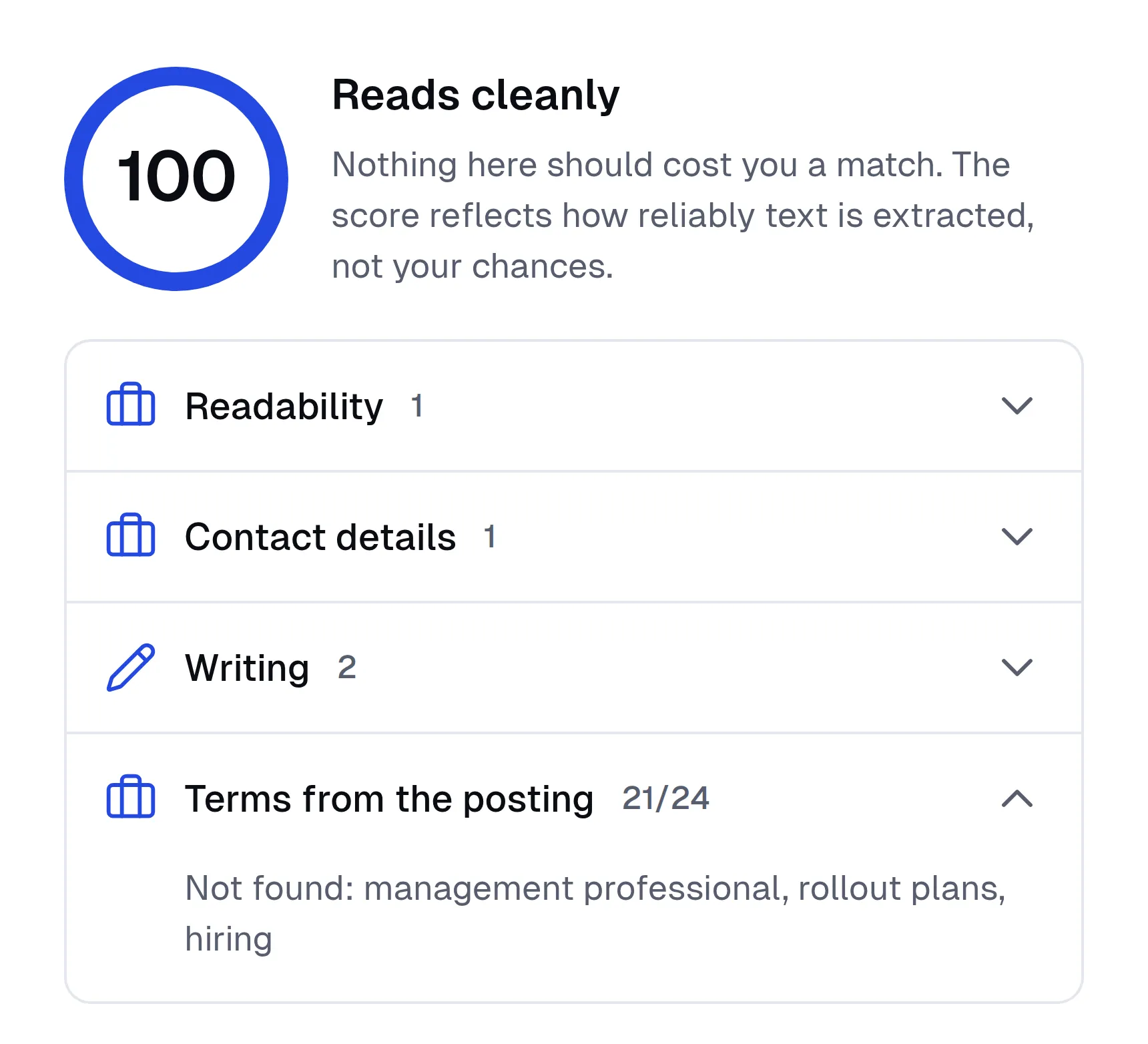
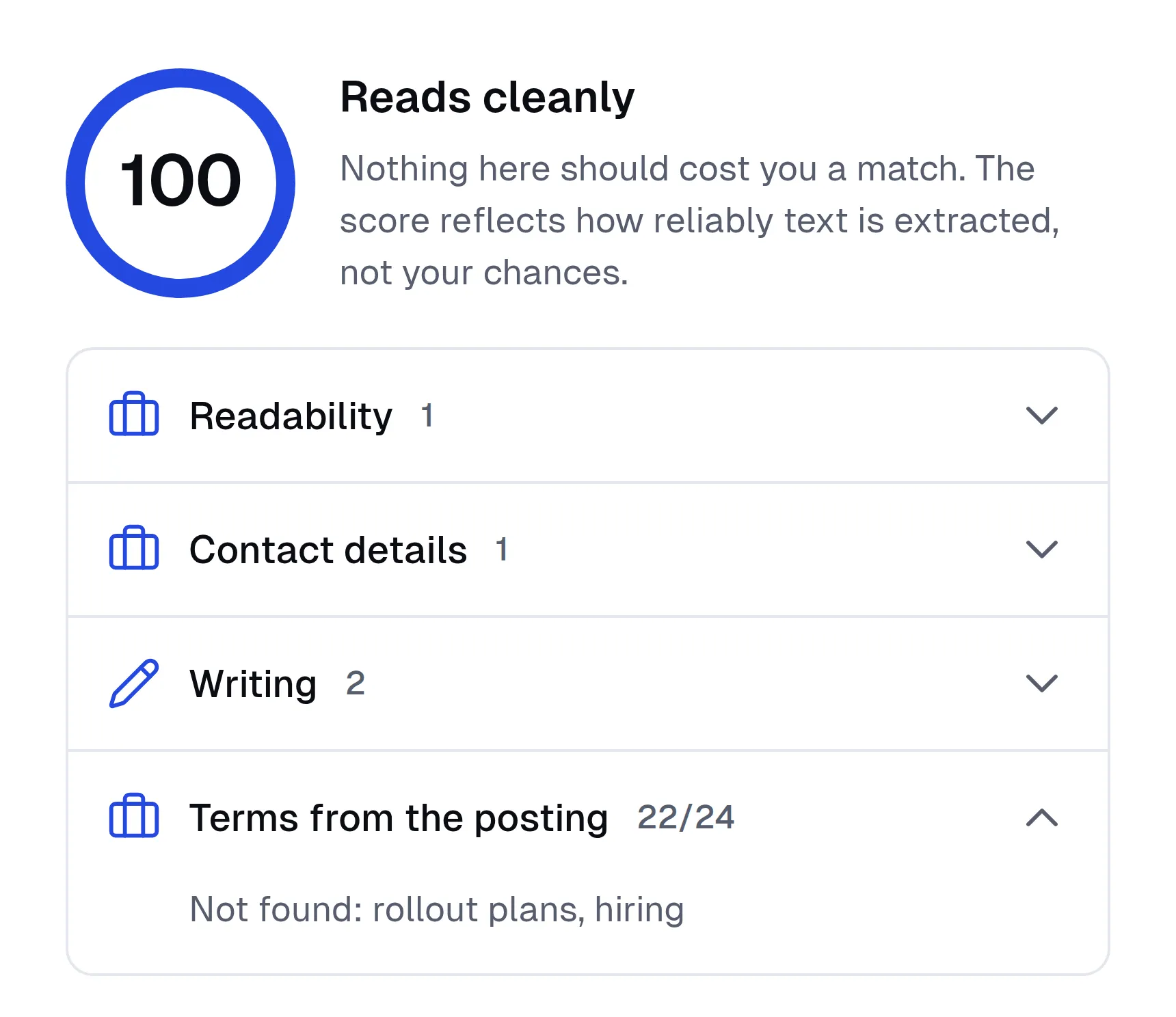
Only the acronym version missed a term from the posting: the checker matched the full name and listed management professional as not found. It never listed PMP as missing, even for version B, which doesn’t contain the acronym, because it didn’t count PMP as one of the posting’s terms. The full name counted wherever it appeared, in the Certifications section or on the header line. In the As software reads it view, every version kept the credential on one readable line, such as Project Management Professional (PMP) May 2024. All four got the same other findings, such as the missing profile link.
This shows what our checker reads, not what every ATS does. The checker itself says its score reflects how reliably text is extracted, not your chances. A term count doesn’t predict an interview either. For your own resume, write the full name and the acronym, as in version C: the full name is what this checker matched, and the acronym helps a reader who knows the credential by its short form. Our ATS-friendly resume guide covers wider PDF-formatting advice.
Mistakes to avoid
- Listing every course, including those unrelated to the role.
- Presenting a course-completion certificate as a separate professional certification or license.
- Using an acronym without the issuer when the qualification is not obvious.
- Burying a required active license beneath unrelated skills.
- Describing an unfinished or lapsed credential as currently held.
- Placing the only mention of a credential inside a decorative image instead of readable text.
Final certification checklist
Questions about resume certifications
Should I include a certification unrelated to the job?
Usually not. Keep one only when it adds relevant evidence or explains a meaningful career change.
Can I put PMP or another designation after my name?
Only if the issuer permits that use and your certification is currently valid. A dedicated Certifications section can provide the full details.
Where do Coursera or Udemy certificates go?
Use Education, Training or Professional development. State the true course title and issuer rather than upgrading it into an occupational license.
Do I need the issue and expiration dates?
Show dates when they help establish a time-limited credential’s current status. Always meet any requirements in the job posting.